Summary
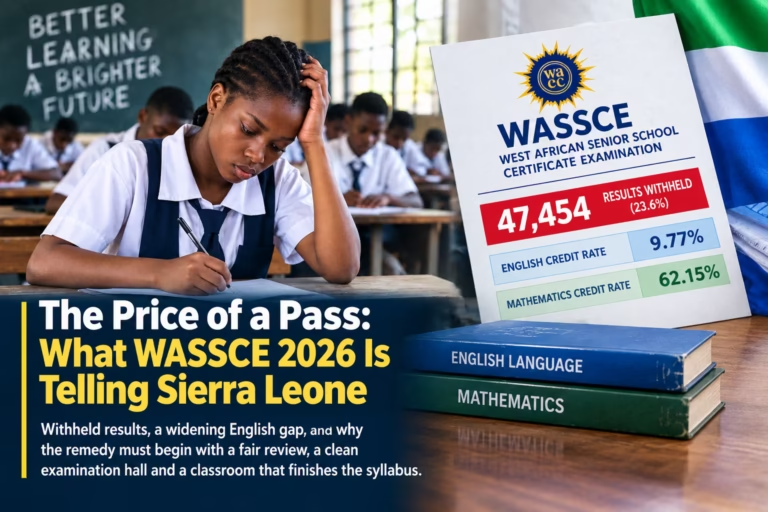
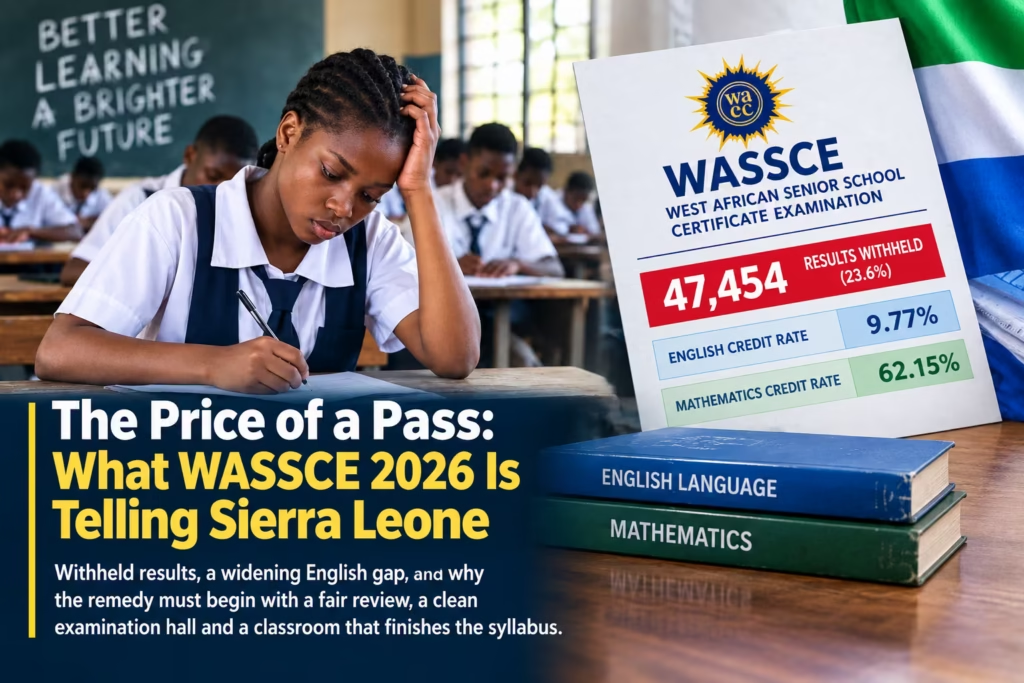
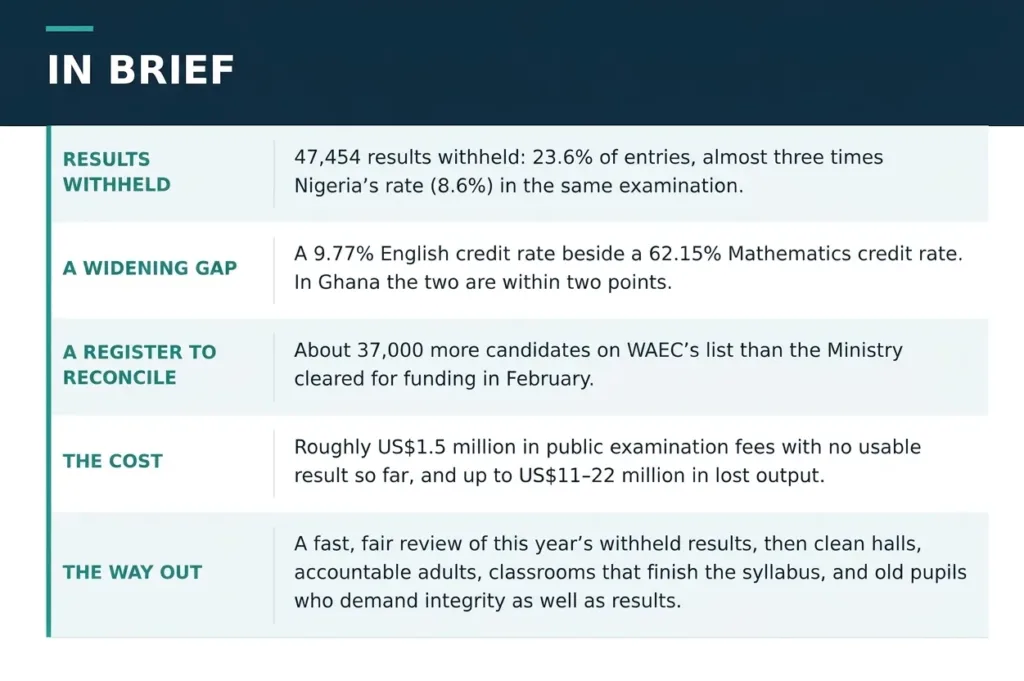
- 47,454 WASSCE results withheld: Nearly one in four candidates who sat the 2026 exam had their results withheld over suspected malpractice, representing 23.6% of all entries
- A serious English-language performance gap: Mathematics credit rate rose to 62.15%; only 9.77% candidates earned a credit or better in English Language
- Honest candidates are paying the price: Thousands of pupils, including 26,735 girls, face uncertainty over university admission
By Dr Mohamed Ibrahim Justice Ganawah
Sierra Leone’s 2026 WASSCE results tell two stories at once. On the surface, more candidates passed than last year. Underneath, one in four candidates who sat the examination has a result withheld for suspected malpractice, and fewer than one in ten earned a credit in English Language. A system that produces more passes and less learning should trouble every one of us.
On Tuesday, 27 October, the Minister of Basic and Senior Secondary Education, Mr Conrad Sackey, announced the results. In homes from Kroo Bay to Kailahun, phones lit up with the WAEC checker. For 47,454 families, the screen showed a single word: withheld.
I write as someone who has stood on both sides of this examination. I sat it at St Edward’s. I taught it there while still a student at Fourah Bay College, and for many years afterwards. Today I coordinate examinations in a university faculty that receives what WASSCE sends us. What I see in these numbers is not simply a bad year. It is a warning that we are drifting towards a system in which passing matters more than learning, and in which honest, hard-working pupils pay for the dishonesty of others.
What the syndicate rooms taught us
When I was a pupil at St Edward’s Secondary School in Kingtom, the WASSCE was something you prepared for in company. We had our own study groups, and we also joined syndicates: private classes where pupils from St Edward’s sat beside pupils from other schools across Freetown, working through the same past questions. Some became institutions in their own right, renowned across the city: Boss Dul, Mr Meeu, Balmer, Teacher P, Trinity and many more.
Those rooms were competitive. Nobody wanted a pupil from another school to finish the comprehension first, or to hear their own name read out low on the list. That rivalry pushed us harder than any fear of failure, and it taught something no syllabus can: that you earn your place by work, in front of witnesses.
This year I looked at the results from my old school with real pride. From what I have seen, St Edward’s candidates performed strongly, and I congratulate the principal, the teachers and every pupil who earned those grades in an honest hall. Their results, like those of Awada in Bo and the Sierra Leone Grammar School in Murray Town, show that excellence remains possible here.
Let me be clear about one thing. Remembering the syndicates is not an argument for paid extra lessons today. They worked because they rewarded effort and competition, not because families paid. A school that teaches well should complete the syllabus within the three years of senior secondary education, and no family should have to buy what the classroom owes its child. My concern is what pupils now invest in. In my day, effort was the currency: you read, you practised, you competed. Today too many pupils, and too many parents, save their money for the examination weeks, to buy access to “materials” that promise the questions or the answers. The syndicate rewarded work. The new market rewards whoever pays at the right moment.
The results, read carefully
On the headline measures, 2026 looks like progress. Underneath, withheld results more than tripled and English fell again.
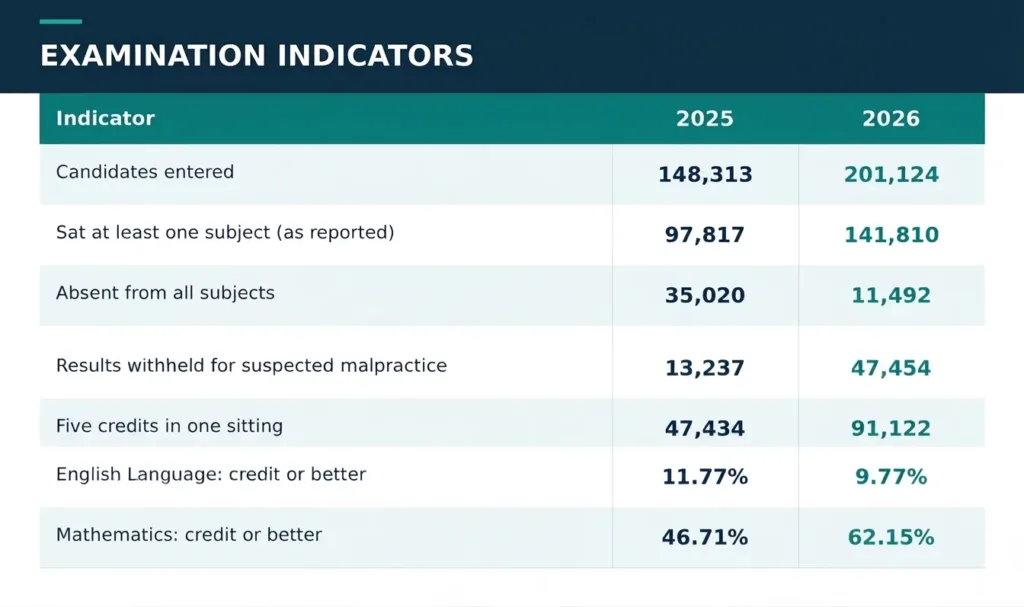
A note on the figures: These figures come from the Minister’s announcement of 27 October, as reported by several outlets; the 2025 figures come from reports of the previous year’s announcement. The Ministry has not yet released full statistical tables. The 2026 figures reconcile: the 200,756 candidates on WAEC’s list are the 141,810 with results, the 47,454 withheld and the 11,492 absent. On that basis, 91,122 five-credit passes are 64.3% of candidates with results. A rate of 52% was reported for 2025 without a stated base, so the two rates may not be strictly comparable. The base for the English and Mathematics percentages has not been stated either, so where I convert them into numbers of pupils, I say so.
One in four under suspicion
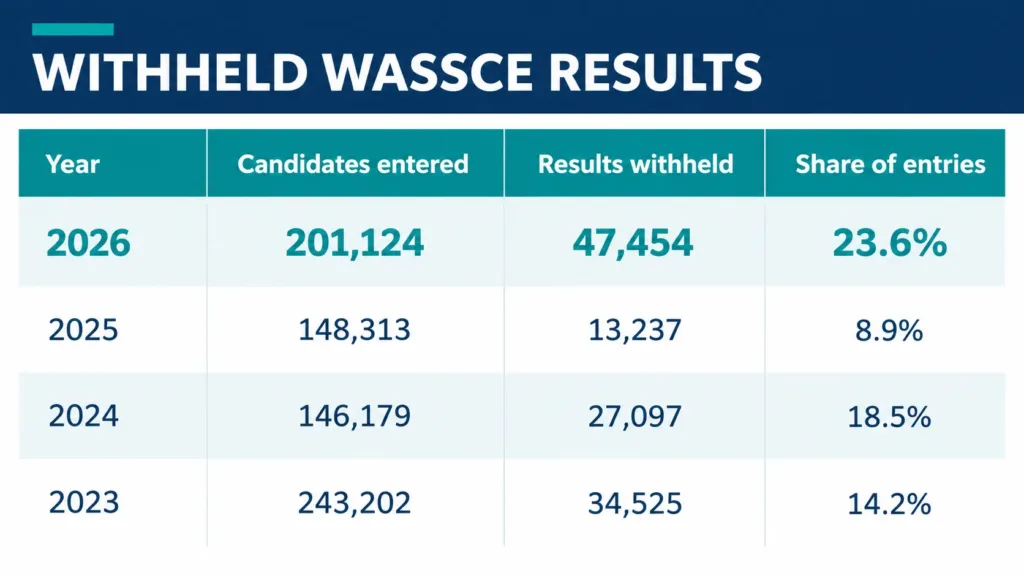
The 47,454 withheld results are 23.6% of all entries, the highest share in at least four years. Leave out the 11,492 candidates absent from every paper, and one in four candidates who actually sat (25.1%) has no result. More than half of them, 26,735, are girls.
The same examination was sat this year across the region. Nigeria withheld 167,486 results, 8.6% of its 1.95 million candidates. Ghana cancelled 8,295 results outright, 1.6% of entries, and is still investigating results at 169 schools. Each national office counts differently, so the comparison is indicative rather than exact. But a rate almost three times Nigeria’s cannot be explained by counting alone.
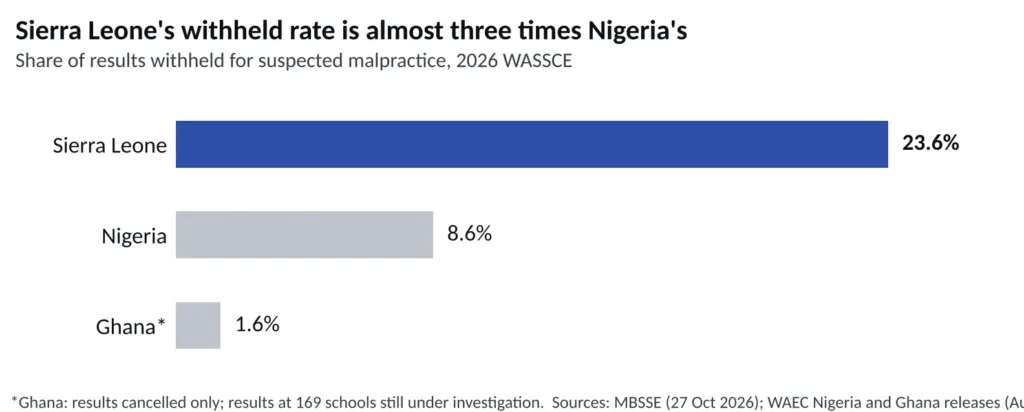
The Ministry suggests that better detection explains part of the rise. That is plausible, and if true it is welcome. But detection can only find what conduct allows. Whether 23.6% reflects more cheating or better catching, it tells us that cheating on this scale was possible in our halls. The Ministry says results were withheld under 13 categories of suspected irregularity, including collusion, answer-sharing inside the examination room, and the use of social media or artificial intelligence to obtain and spread answers. Most of the methods named need a phone in the hall, or an adult who looks away.
One more figure needs explaining. In February, the Ministry announced that 219,171 candidates had been uploaded for government-funded WASSCE, that 55,174 were struck off after verification, and that 163,997 were cleared. WAEC registered 201,124 candidates for this year’s examination, about 37,000 more. There may be entirely legitimate reasons, such as fee-paying candidates or entries reinstated on review. The Ministry should simply set them out, because public trust in the results depends on public trust in the register.
The withheld results: review them urgently, and fairly
Behind the figure of 47,454 are 47,454 young people, and their families, waiting. They deserve an urgent review. They also deserve a fair one, and those two goals pull in different directions.
The case for caution is real. WAEC withholds results when it suspects irregularities, and a credible examination depends on that power being used. Releasing every result to relieve public pressure would reward those who cheated, insult those who did not, and tell next year’s candidates that malpractice carries no risk. Every honest certificate would lose value.
The case for urgency is just as real. A withheld result is a suspicion, not a verdict, and many of these candidates may have done nothing wrong: when a whole hall or centre is flagged, honest pupils are caught alongside dishonest ones. Every week of delay has consequences:
- Lost places. Admissions to universities and colleges for 2026/27 depend on these results. A candidate without a result cannot take up a place, a scholarship or a job that requires a certificate, and may lose a full year.
- Lost pupils. Families who cannot afford another attempt may withdraw their children altogether. With 26,735 of those affected being girls, the risk of losing young women from education is serious.
- Lost trust. Long silence breeds rumour, protest and possibly legal challenge, and it erodes confidence in WAEC and the Ministry at the moment they most need it.
- Lost deterrence. Cases that drag on and quietly disappear teach nothing. A swift decision, either way, is what changes behaviour.
The answer is not to choose between integrity and fairness, but to deliver both, quickly. A credible review would:
- Set and publish a deadline. Ghana committed to deciding its outstanding cases by 30 October, about eight weeks after releasing results. Sierra Leone should do the same.
- Judge individuals, not halls. Each decision should rest on evidence about the candidate. In October 2025 a Ministry spokesman said of that year’s seized results: “We are requiring evidence before results are canceled.” That principle should govern every case this year.
- Release in batches. Where the evidence against an individual is weak or absent, release the result as soon as that is clear, rather than waiting until every case is resolved.
- Give reasons and a right of appeal. Candidates whose results are cancelled should be told why, and be able to challenge the decision before an independent panel.
- Report progress publicly. A simple count, updated every two weeks, of cases decided, released and cancelled would do more for trust than any statement.
- Hold places open. Universities and colleges could offer provisional admission to withheld candidates until decisions are made, so that the innocent do not lose a year to delay.
Where malpractice is confirmed, the result should be cancelled and the adults who enabled it pursued. Where it is not, the result should be released without stigma. Either way, the decision should come in weeks, not months.
Two subjects, two stories
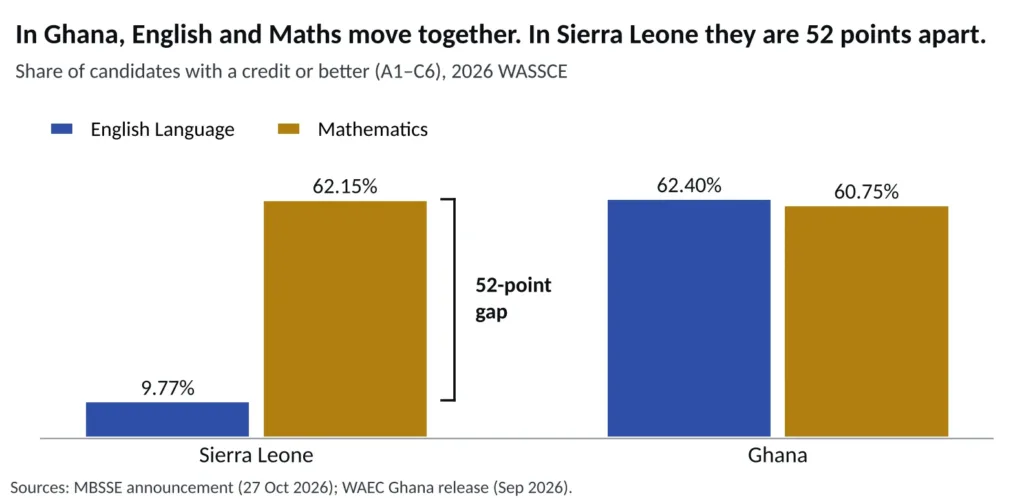
In one year, the share of candidates with a Mathematics credit rose from 46.71% to 62.15%. In the same year, English credits fell from 11.77% to 9.77%.
Taken at face value, a 62.15% Mathematics credit rate is good news, and the many candidates who earned their credits honestly deserve our congratulations. But I would be failing in honesty if I did not say what many teachers, parents and lecturers are saying in private: they do not believe that all of these results were merited. The jump does not match what they see in classrooms, and it sits beside an English result moving the other way. That doubt may be unfair to many candidates. Yet the doubt is itself a cost, because when the public cannot trust a good result, it is the honest achiever who loses most. The only way to settle it is with evidence, not opinion.
The Mathematics rise on its own proves nothing. Ghana’s Mathematics credit rate also rose this year, by 12 points to 60.75%, which suggests a regional factor such as the paper itself. Our 2026 sitting also used a dual curriculum for the first time, with 20 subjects examined on the new curriculum and 17 on the old, and that may have moved results in ways we do not yet understand.
What sets Sierra Leone apart is not the rise but the gap. In Ghana, English and Mathematics credit rates are within two points of each other: 62.40% and 60.75%. In Sierra Leone they are 52 points apart. Mathematics papers also demand reading, so the two subjects usually move together. When they come apart this far, there are two possible explanations, and both should worry us. The first is that English teaching has failed badly. The second is that short objective and numerical answers, which travel easily by phone, are reaching candidates during the examination, while essays and comprehension answers cannot. WAEC and the Ministry hold centre-level data that can tell the two apart. A centre where most candidates earn Mathematics credits and almost none earn English credits is where any inquiry should begin.
The English decline itself is beyond dispute. The credit rate was 17% in 2023, 11.77% in 2025 and 9.77% in 2026, despite a national conference on the English crisis in March this year. Most degree programmes require credits in both English and Mathematics. In 2025, only 7,024 candidates had five credits including both, out of 47,434 with five credits of any kind. This year 91,122 have five credits, yet fewer than one in ten candidates holds the English credit that turns five credits into a university place.
The classroom matters as much as the hall
It would be wrong to blame this only on cheating, or on pupils. Free Quality School Education has been a genuine achievement in access. The Ministry’s own analysis shows that WASSCE candidature rose by 354% between 2018 and 2021, to a record 156,231, and attributes the rise largely to the programme (MBSSE, 2021 WASSCE Results Analysis, pp. 5–6). But access has run ahead of the conditions for learning. The Government’s Education Sector Plan 2022–2026 found that public spending on education was 2.8% of GDP in 2020, well below the 4–6% recommended under the global education goal, SDG 4 (pp. 12–13). It found 82 senior secondary pupils for every qualified teacher (p. 19), and that only 46% of teachers in approved government and government-assisted schools were paid by the government (p. 18). A teacher who is unpaid, unqualified, or facing a class of that size cannot finish the syllabus.
English has a further disadvantage: it is often not the language our children speak, even at school. Walk through almost any school compound, at break time, in the corridors, even in the classroom, and you will hear Krio everywhere. A study of four senior secondary schools in Kenema found exactly this: “pupils, as well as teachers, use Krio in school more often than English” (Dauda, 2022). Krio is a national treasure, the language that binds us together, and no child should be made to feel ashamed of speaking it. But English is the language of the examination, the university and most formal work, and nobody masters a language they meet only in a textbook. A pupil who reads English only in lessons, hears it rarely and speaks it almost never arrives at the WASSCE English paper badly underprepared. Schools can change this without disrespecting Krio: English-speaking and debating clubs, reading societies, assemblies conducted in English, and teachers who model good spoken English every day.
And who is teaching English? Too few people trained to do it. The most detailed study of Sierra Leone’s teaching workforce, by the Education Commission’s Education Workforce Initiative, found that in 2019 one junior secondary school in five (360 schools) had no English specialist at all. Senior secondary schools were better covered on paper, but the study estimated that the teacher-training colleges produce at most about 129 new English specialists a year, and that at this pace it would take around 24 years to staff every English classroom the country will need once all children are enrolled (Education Commission, 2020, pp. 11, 15). Even those counts rest on teachers’ own description of their subject. Across the whole system, the latest school census found that only 64% of teachers were qualified for the level they teach, and a quarter had no teacher training at all (MBSSE, Annual School Censuses 2023 and 2024). There is no published national figure for how many English graduates the country produces each year, and that silence is part of the problem: we cannot fix an English crisis we have not counted. The Ministry, the Teaching Service Commission and the universities should publish how many qualified English teachers we have, where they are and how many we are training, and make English teacher education a scholarship priority.
Pupils respond to the incentives adults create. If schools do not finish the syllabus, and halls do not stop phones, some pupils will conclude that buying answers is the rational choice. The task is to make honest study the only choice that works.
What it costs us
Government pays WASSCE fees for every eligible pupil. The Ministry’s February statement that removing 55,174 entries would save US$1.37 million implies a fee of about US$25 per candidate. On that basis, and assuming most of them were government-funded, the fees paid for the 47,454 withheld candidates and the 11,492 who sat no paper come to about US$1.5 million, roughly a third of the bill for the 163,997 cleared candidates.
The economic cost is larger. If every withheld candidate lost a full year before entering further study or work, and that year is valued at a quarter to half of average output per head (about US$946 in 2026, on IMF projections), the loss would be US$11–22 million, about 0.1–0.3% of GDP. The true figure will be lower as results are released, but even the low end is several times the fees involved.
The deepest cost is to the value of the certificate itself. A certificate is a signal: it tells a university or an employer what it cannot see directly. When certificates can be bought, every certificate is discounted, including those earned honestly. The pupil who earned six credits by hard work now carries the same paper as the pupil who bought them, and both meet suspicion. Some universities add their own entrance tests, employers fall back on personal networks, and our strongest students look abroad. For an economy that needs a literate, numerate workforce to grow and to widen its tax base, roughly 90,000 young people failing English in one year (if the 63.33% failure rate applies to those with results) is not a schooling statistic. It is a growth problem.
The human cost
The heaviest price of malpractice is paid by pupils who did nothing wrong. A withheld result is a suspicion, not a verdict, but to the child who waits it feels like a sentence without an end date. After the 2024 results, candidates whose results were withheld wrote in comments online that three years of schooling had gone to waste and that their parents could not afford another attempt. That is how dropouts are made.
The honest pupil who passed suffers too, in a quieter way. They see classmates with better grades who did not study, and draw a corrosive lesson: that effort is for the naive. Some will not choose effort next time. And the pupil who bought their credits pays later, on reaching university or work, when it becomes clear that the certificate did not come with the skills. Universities, my own included, see that gap every year.
Young people deserve better than to carry the blame for failures that adults designed. They need clear reasons, fast decisions and counselling when results are withheld, and a system that rewards the effort we ask of them.
The exam hall is where integrity is lost
The integrity failure is not in the syllabus or the marking. It is in the conduct of the examination. Pupils carry phones into halls, and some supervisors allow them to use them. Stop that, and the market for leaked answers collapses, because answers are worthless if they cannot reach the candidate. When pupils know they will be watched and cannot cheat, they will study.
Enforcement is possible. This year Ghana cancelled the entire results of 861 candidates caught with mobile phones. The Minister has warned that supervisors, invigilators, centre managers, principals and proprietors who facilitate malpractice could face disciplinary action, with repeat offenders referred to the Anti-Corruption Commission. That is the right target, but “could” is not enough. The 2027 examination should carry six commitments:
- No phone in any hall. Candidates are checked at the door. A candidate found with a phone during a paper has that paper cancelled, and the supervisor of the hall answers for it.
- Supervisors answer for their halls. Where a hall shows collusion, its supervisor and invigilators are barred from examination duty for at least five years, referred to the Teaching Service Commission, and prosecuted where money changed hands.
- Supervisors from elsewhere. Supervisors serve outside their home districts, are rotated each year, and are paid properly and on time.
- Papers that cannot be copied. Several versions of each objective paper make a WhatsApp answer string useless. Packets are sealed, serial-numbered and opened in front of candidates.
- A law with teeth, and its enforcement. The WAEC bill should create criminal offences for leaking, selling, buying or circulating papers and answers. A law is necessary but not sufficient: Nigeria has had one since 1999 and still withheld more than 160,000 results this year. What deters is the certainty of being caught.
- Speed and fairness. The deadline and safeguards set out above for this year’s withheld results should become permanent rules for every future sitting.
These measures cost money. The US$1.37 million the Ministry expects to save from register verification, if ring-fenced, would be a sensible place to start, and the WAEC bill should come with a full costing.
An emergency, properly defined
Sierra Leone has declared national emergencies before, for disease outbreaks and for drug abuse. A system in which a quarter of candidates are suspected of cheating and nine in ten cannot earn an English credit deserves the same seriousness. An emergency is not a slogan. It is a time-bound plan, a named lead, ring-fenced funding and regular public reporting. Over 24 months it should deliver:
- Clean examinations: the six commitments above, in force for the 2027 WASSCE.
- A clean register: the unique learner identification system live before 2027 registration and linked to BECE records.
- A finished syllabus: syllabus coverage checked each term in every school and reported publicly, so that no family needs to pay for extra lessons.
- Teachers who can teach English: testing and retraining of English teachers, with approved teachers placed on the payroll.
- Reading from the start: reading assessed at the end of primary and junior secondary school, and books in every classroom.
- A bridge for the stranded: a funded English bridging year, recognised by universities and TVET institutions, for candidates with five credits who failed English.
- Healthy competition: free inter-school academic competitions in every district, bringing back the spirit of the syndicate rooms inside the school system.
To the old boys and old girls
Across Sierra Leone, past pupils’ associations quietly hold our schools together. They rebuild classrooms, re-roof dormitories, equip laboratories, sink boreholes, sponsor prize-giving days and pay the fees of pupils who would otherwise drop out. Their contribution deserves real gratitude. And many of the men and women who lead those associations now sit in the strategic seats of this country: in ministries and Parliament, in banks and businesses, in the courts and the security services, in our universities, churches, mosques and newsrooms. I write this as one of you.
Buildings matter. But a school is not its buildings. A school is the character of the people it sends into the world. None of us would accept a new laboratory paid for with stolen money. We should not accept a pass list built on stolen answers either.
The temptation is understandable. Every association wants its school near the top of the table on results day, and it is easy to celebrate a perfect pass rate without asking how it was achieved. But a grade that was not earned in an honest hall is not a credit to the school. It is a debt, and the pupil pays it later, in a lecture theatre or an interview room where the certificate no longer protects them. Let us not fight for good results that are not built on merit. Let us fight for good results that are.
So I appeal to the old boys and old girls of every school, and above all to those of us now holding positions of influence in the public and private sectors:
- Make integrity part of the gift. When your association funds a project, let it come with a clear expectation, agreed with the school: no tolerance for malpractice, and results that are earned.
- Fund learning, not only buildings. Libraries and textbooks, reading clubs, English and Mathematics clinics, and support for teachers to finish the syllabus. That is how lasting results are built.
- Come back to the classroom. Give one afternoon a term to talk with pupils about how you got where you are, and what honest work cost you. Young people listen to those who once sat in their seats.
- Sit down with the school authorities. Ask the principal, plainly, how the school will keep its halls clean and its syllabus finished, and offer practical help to make it happen.
- Celebrate honest excellence. Reward the pupil who earned six credits by hard work, and honour the teacher who refused to look away.
- Never shield a cheat. If our own school is found to have enabled malpractice, let us be the first to demand accountability, not the first to ask for it to be overlooked.
Our schools made us. Many of us owe our careers to a teacher who would not let us take a shortcut. The best way to repay that debt is not only a new building with our year group’s name on it. It is a generation that passes because it learned. That would be the finest monument any old boy or old girl could leave behind.
We cannot continue like this
The 2026 WASSCE asks a plain question: do we want certificates, or do we want educated young people? For years we have been getting more of the first and less of the second.
The 47,454 withheld results and the 9.77% English credit rate are two faces of one failure. When children are not taught to read and write well, the system hands them a reason to cheat. When the adults who sell papers and open halls to phones go unpunished, the next cohort learns that study is optional.
The state of affairs is sad for our country. What we need now is an honest and intentional national conversation, with parents, teachers, principals, past pupils, WAEC and Government at the same table, about the kind of education we want and what each of us is prepared to do to secure it.
I still remember the syndicate rooms: the heat, the chalk dust, and the fear of being beaten to the answer by a pupil from another school. That fear made us. Our children deserve the same chance to earn what they get, in classrooms that teach them and halls where honesty is no disadvantage. The results are out. The real examination is now ours.
Dr Mohamed Ibrahim Justice Ganawah is Senior Lecturer in Economics at Fourah Bay College, University of Sierra Leone, Vice President of the Economic Association of Sierra Leone, and Founder and Editor-in-Chief of Ganawah’s Insight Corner. He writes in a personal capacity.
Sources
- Government of Sierra Leone Releases 2026 WASSCE Results (Sierraloaded, 27 Oct 2026)
- 2026 WASSCE: WAEC Withholds 47,454 Results in Sierra Leone (Sierraloaded, 27 Oct 2026)
- 47,454 WASSCE Results Withheld as Alfred Farwell Thorpe Emerges Best Pupil (Calabash, 28 Oct 2026)
- 2026 WASSCE results: 47,454 results withheld; 63.33% fail English (AYV, Oct 2026)
- MBSSE Analyzes 2025 WASSCE Results and Pledges to Improve Education (Ministry of Information and Civic Education, 21 Oct 2025)
- 2025 WASSCE: English Language Results Hit Record Low (Sierra Leone Monitor, 16 Oct 2025)
- WAEC Withholds Over 20,000 WASSCE Results (Sierraloaded, 10 Oct 2024)
- 2023 WASSCE: 137,796 Passes, 34,525 results seized (AYV, Oct 2023)
- Govt to Fund All Eligible WASSCE Candidates (Premier News, 11 Feb 2026)
- Education Stakeholders approve dual curricula for 2026 WASSCE (Premier News, Nov 2025)
- WASSCE English Paper Rescheduled Over Leaked Questions (Sierraloaded, 10 Jun 2026)
- Sierra Leone Tackles its English Language Crisis (Sierraloaded, Apr 2026)
- 2021 West African Senior School Certificate Examination Results Analysis (Ministry of Basic and Senior Secondary Education, 2022), pp. 5–6
- Sierra Leone Education Sector Plan 2022–2026 (Government of Sierra Leone, 2022), pp. 12–19
- Impact of Krio Language on the Use of English as a Foreign Language (J. Dauda, Journal of English Language Teaching and Applied Linguistics 4(3), 2022)
- WAEC withholds 167,486 SSCE results over alleged examination malpractice (Sahara Reporters, 5 Aug 2026)
- English Language performance falls to 62.4% (MyJoyOnline, Sep 2026)
- WAEC has cancelled or withheld results of 8,295 candidates (Graphic Online, Sep 2026)
- Education Workforce Supply and Needs in Sierra Leone (Education Commission, Education Workforce Initiative, 2020), pp. 11, 15
- Annual School Censuses 2023 and 2024, draft report (MBSSE, 2024)
- Sierra Leone GDP per capita, IMF World Economic Outlook projections (via Statistics of the World)
- Examination Malpractices Act 1999 (Nigeria) (Laws of Nigeria)
- 2024 in Sierra Leone and 2025 in Sierra Leone (national emergencies)
- Shares, ratios, the implied examination fee and the cost estimates are the author’s calculations from the figures above.