By Rose Aba Akafo
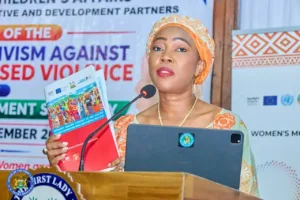
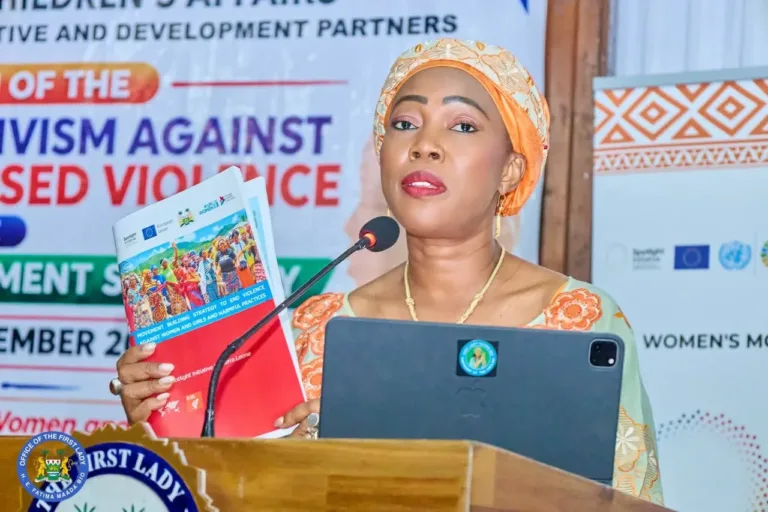
First Lady Fatima Bio on Wednesday formally launched a new National Women’s Strategy in Freetown as the Ministry of Gender and Children’s Affairs kickstart the 16 days activism campaign against gender-based violence, with calls for justice for survivors and to put an end to impunity.
The event marked the start of an annual global campaign to raise awareness and mobilise collective action to end violence and discrimination against women, which runs from 25 November, the International Day for the Elimination of Violence Against Women, to 10 December, the International Human Rights Day.
Isatu Jabbie Kabba, chairperson of the ceremony and gender adviser to President Julius Maada Bio, said the occasion was an important moment in their collective effort to address gender-based violence in the country, citing the global UNiTE theme, “Unite to End Violence against Women and Girls: Ensure Justice, Protect Survivors, End Impunity.”
Addressing the First Lady, Deputy Minister of Gender and Children’s Affairs, Hindowa Bindi, said the fight against gender-based violence is a national responsibility that requires collective action, adding that Fatima Bio’s presence was a reaffirmation of that commitment to building a society where women and girls are free from violence and discrimination.
He called for national backing against GBV, placing greater responsibility on communities to ensure women and girls are protected.
Women’s Forum president Sally Adams described the occasion as a moment of reckoning and an opportunity to change the narratives surrounding the experiences of women and girls.
With about 43 million girls worldwide aged 15-19 years reported by UN Women to have experienced intimate partner or non-partner sexual violence at least once in their lifetime, and less than 40 percent of women who experience violence seek help of any sort, Adams stressed that generations of women have lived with stories of tears and silence, but that era of silence must now come to an end. She called for a paradigm shift in community approaches to sexual and gender-based violence (SGBV) matters, saying that perpetrators should be named and shamed instead of the victims.
“If we don’t fight for the girl child today, we shouldn’t expect a just society tomorrow,” she said, calling for an end to impunity for violence against women.
A representative of the Inspector General of Police said violence against women and girls must never be tolerated, excused or normalised, and acknowledged the police’s responsibility to bring perpetrators to justice.
She outlined commitments to strengthen investigations, ensure proper handling of evidence, treat survivors with dignity and respect, and address gender exploitation, abuse and harassment within policing responsibilities. She also stressed partnerships and community engagement, assuring women and girls that the police would pursue justice without fear or favour.
Development Partners Reaffirm Support
Development partners present at the ceremony renewed their commitment to supporting Sierra Leone’s efforts to end gender-based violence.
Head of Mission at the Embassy of Iceland, Ásdís Bjarnadóttir, said the theme is a powerful reminder that ending gender-based violence takes more than awareness and declarations. She reaffirmed Iceland’s commitment to initiatives that protect survivors, strengthen support systems and ensure perpetrators are brought to justice.
Ambassador of Ireland to Sierra Leone, Patrick McManus, said one in three women globally experiences gender-based violence in her lifetime. He acknowledged the progress made in Sierra Leone over the years, and added that the experiences and needs of survivors must be placed at the centre of response.
British High Commissioner to Sierra Leone, Josephine Gauld, called for stronger justice systems, better quality services for survivors and accountability for perpetrators. She said greater progress is possible through collaboration among governments, institutions and development partners.
Representing the European Union Delegation, I. K. Foday argued there can be no justification for violence and the campaign must not be limited to 16 days of speeches but must translate into 365 days of action. He explained that the EU’s commitment goes beyond advocacy to investing in institutions and improving services for survivors, and called for increased national resource allocation to the Ministry of Gender and other institutions involved in combating gender-based violence.
First Lady Calls for Shift from Promise to Action
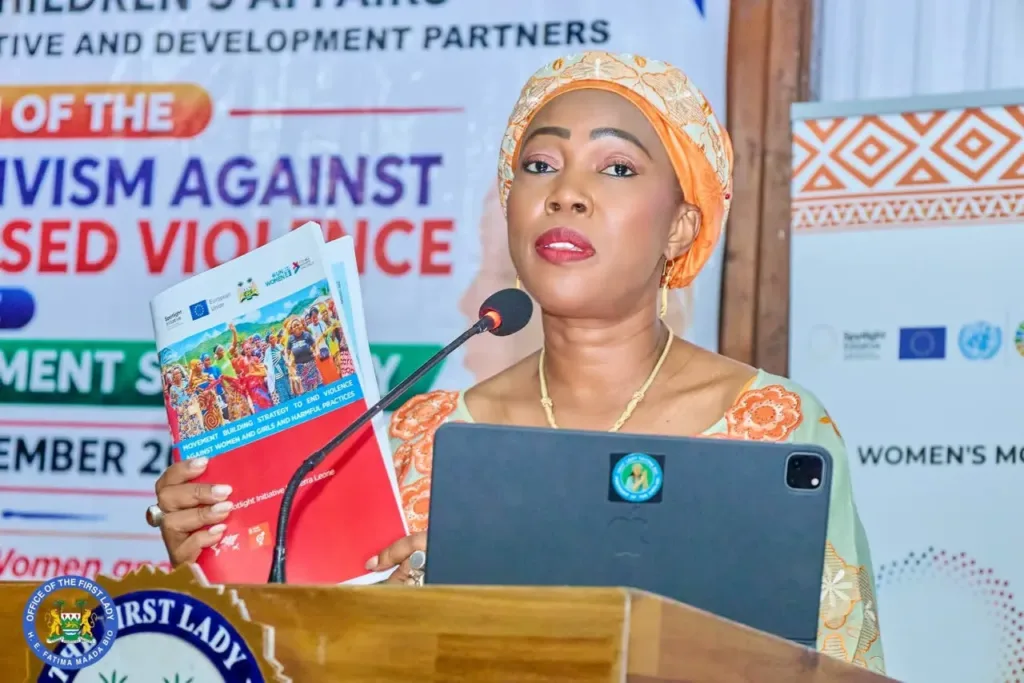
Delivering the keynote address, First Lady Fatima Bio described gender-based violence as a national, human rights and development issue, not merely a women’s issue. She said it threatens families, weakens communities and undermines the country’s future, noting that behind every statistic is a human being whose life has been affected.
She stated that there are girls whose education has been interrupted, women living in fear in their own homes, and survivors carrying trauma in silence because of societal pressure. She believes that the responsibility for violence rests with the perpetrator and never with the survivor.
She called for an end to the culture of silence, blame and impunity, pointing to her “Hands Off Our Girls” campaign, through which she mobilises action to end child marriage and teenage pregnancy.
“Our girls deserve protection, our women deserve dignity,” she said, urging stakeholders to move from promises to implementation, from awareness to accountability and from advocacy to measurable action. She said policies must respond with professionalism and compassion, while the justice system must act decisively, and appealed for schools, homes, workplaces and communities to become safe spaces for women and girls.
Addressing men and boys, she described them as indispensable partners in the fight against SGBV. She said society must raise boys who understand that strength is shown through respect, responsibility, compassion and integrity, not domination or violence. She also noted that boys also experience gender-based violence.
She stated that survivors should not be defined by the violence committed against them, rather society owes them justice, healing and opportunities to rebuild their lives.
National Women’s Strategy
On the National Women’s Strategy, the First Lady said Sierra Leone cannot achieve prosperity while half of its population remains excluded from opportunities, leadership and decision-making.
She described women as the backbone of households, institutions and communities. The strategy, she said, must not become a document left on the shelf but a living instrument for organising women, strengthening solidarity, advancing economic empowerment and ensuring their voices are heard.
Read: WAIIS 2026 wraps up in Lungi with 20 deals and launches across transport, energy, digital and food security
The ceremony featured a paper by Dr. Aisha Fofanah Ibrahim of the Rainbo Initiative and the Institute of Gender Research and Documentation at Fourah Bay College. The research examined why women do not report sexual and gender-based violence, the common forms of abuse, available reporting channels, factors behind underreporting, and how they cope, among other things.
Other speakers included the Human Rights Commission of Sierra Leone Chairperson Narsu Ndanema; Deputy Minister of Social Welfare Mohammed Haji-Kella; and Minister of Basic and Senior Secondary Education Conrad Sackey.
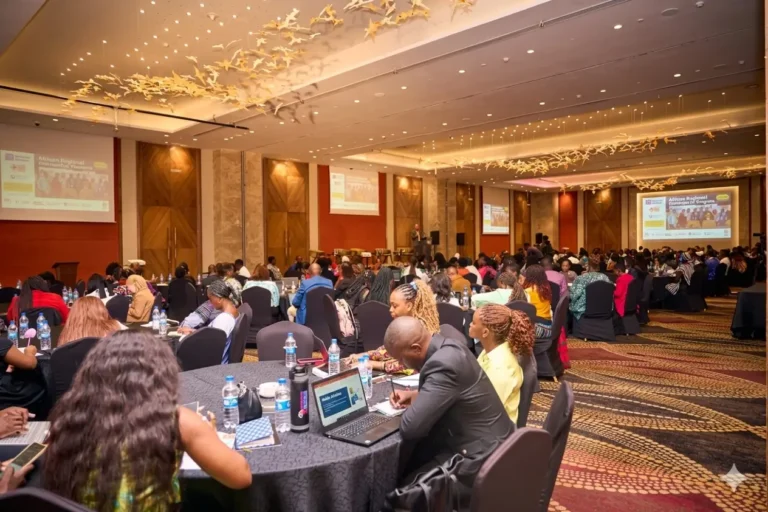
The launch brought together government officials, development partners, civil society organisations and women’s groups, reaffirming the need for sustained collaboration to end gender-based violence and protect women and girls in Sierra Leone.