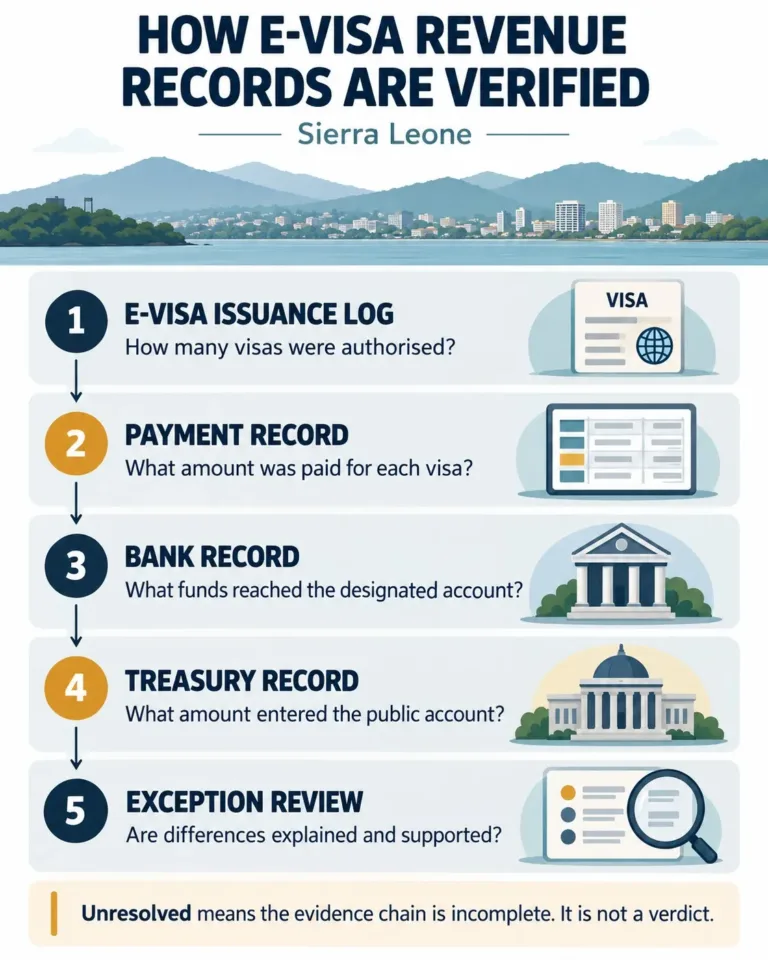
An electronic visa, or e-visa, generates an immigration record and may also involve a fee and payment transaction. For a government to account properly for the revenue, it must be able to establish which visas were issued, how much revenue was due and collected, and whether the relevant funds reached the appropriate public accounts.
These records serve different purposes. Immigration records establish the status of visa applications and decisions. Payment records show the amounts collected and settled. Government accounting records show the revenue recognised and transferred into public accounts. Bank statements provide independent evidence of the movement of funds.
A reliable reconciliation connects these records, identifies differences and documents how they were resolved.
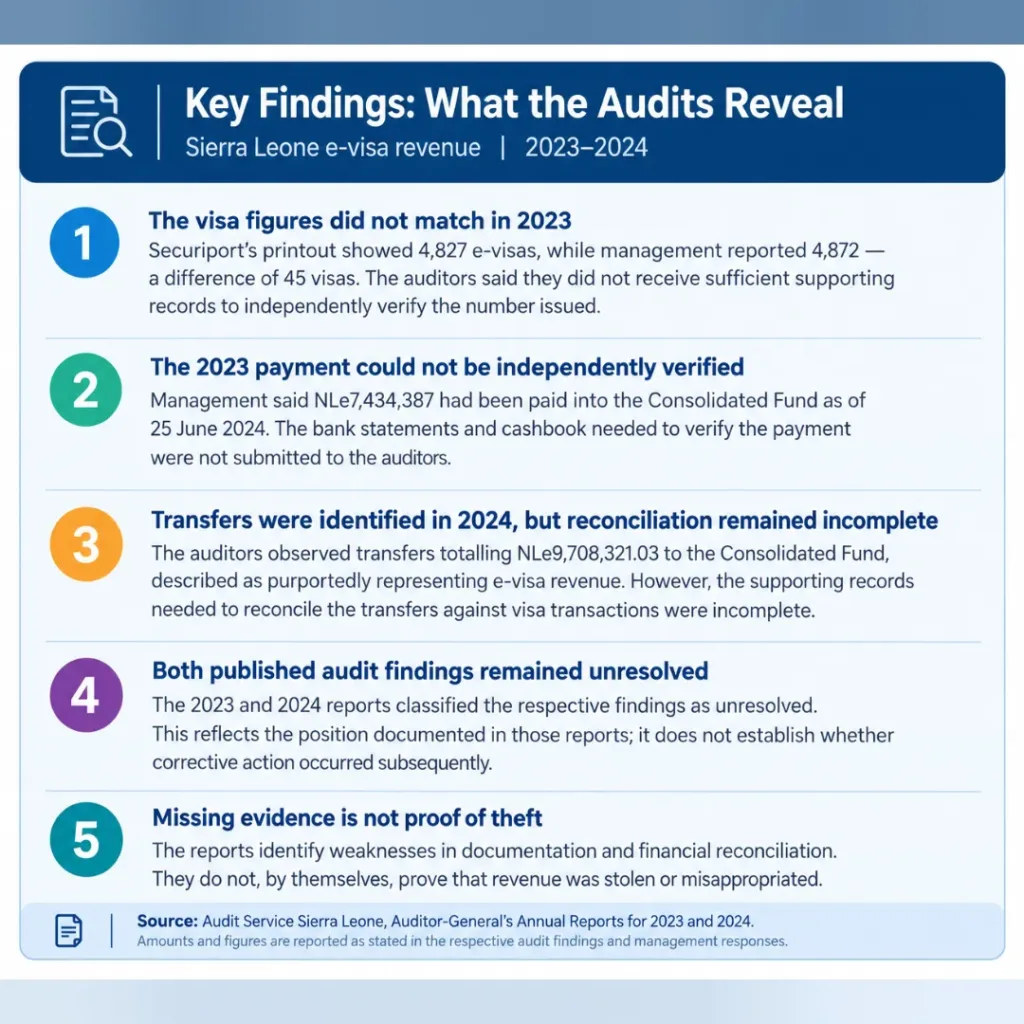
Sierra Leone’s Auditor-General’s Annual Reports for 2023 and 2024 identified weaknesses in the documentation and reconciliation of e-visa revenue administered through Securiport and the Sierra Leone Immigration Department (SLID). The reports do not, by themselves, establish that money was stolen or misappropriated. They show that the supporting evidence required to verify the reported visa figures and revenue was incomplete.
This explainer examines what the reports actually say, why the gaps matter and what a sound reconciliation process should involve.
The records needed to reconcile e-visa revenue
The following four-part framework explains the records normally needed to establish a reliable connection between visa issuance and public revenue. It is a recommended control model based on the audit findings, not a claim that the Auditor-General prescribed an official four-record framework.
1. Immigration and visa records
The immigration record should provide a reliable account of applications processed and visas issued. Depending on the system and applicable rules, it should distinguish approved applications, issued visas, rejected applications, cancellations, exemptions and refunds.
Relevant information may include the visa category, applicable fee, transaction date, currency and unique application or payment reference.
The purpose is to enable authorised officers and auditors to establish the number of visas issued and determine the corresponding revenue due. Personal information should be protected, but the audit team must have sufficient authorised access to verify the records.
2. Payment and settlement records
The payment operator’s records should show the amounts collected against individual transactions, the payment channel used, applicable fees, reversals and refunds, and any outstanding settlement balances.
Where an escrow or collection account is used, the records should also identify amounts awaiting transfer and the relevant settlement periods.
These records help establish how much money was collected, what deductions or adjustments applied, and how much should have been transferred to the government.
3. Government accounting records
The responsible government accounting officers should maintain records showing the revenue received, the period to which it relates, the relevant account entries and any authorised adjustments.
These records may include the government cashbook, treasury account records and supporting receipts. They should enable the reported revenue to be traced to the appropriate public accounts.
4. Bank and transfer evidence
Bank statements and transfer confirmations provide evidence of the movement of funds between the collection or escrow account, any intermediate account, the Immigration Treasury Account and the Consolidated Fund, as applicable to the payment arrangements.
Not every transaction will necessarily pass through every type of account. The actual sequence should be established from the applicable contractual and banking arrangements.
The central requirement is that the records should collectively demonstrate how payments were collected, settled, transferred and recorded.
A reconciliation brings these records together, explains differences and documents the evidence supporting the final figures.
What the 2023 audit found
The Auditor-General’s Annual Report for 2023 addressed the issue under paragraph 4.40.2, titled “Revenue from the Issuance of E-Visa by the Securiport not Brought to Account.”
The report stated that a review of a printout supplied by Securiport showed that 4,827 e-visas were issued in 2023.
However, the escrow bank statements and cashbook were not submitted for audit inspection. The auditors also reported that the Immigration Department failed to provide the relevant documents needed to independently confirm the number of e-visas issued.
In its official response, management stated that 4,872 e-visas had been issued as at 31 December 2023, according to data provided by Securiport. This differed from the 4,827 recorded in the printout reviewed by the auditors, a discrepancy of 45 visas.
Management also stated that, as of 25 June 2024, Securiport had paid NLe7,434,387 into the Consolidated Fund. The Immigration Department said it had requested a breakdown identifying the number of e-visas covered by the payments and the periods to which they related.
The Auditor-General acknowledged management’s response but noted that bank statements and the cashbook needed to confirm the payment had not been submitted. The report therefore classified the issue as unresolved.
The distinction is important: NLe7,434,387 was the amount management said had been paid, not a payment independently verified by the audit evidence described in the report.
Source: Audit Service Sierra Leone, Auditor-General’s Annual Report 2023, paragraph 4.40.2, pp. 194–195. Read the official report.
Why the difference matters
The discrepancy between 4,827 and 4,872 cannot be resolved simply by choosing one figure. The underlying records must establish which figure is correct and explain the difference.
Possible causes to investigate in a reconciliation include reporting period differences, duplicate entries, cancellations, differences between approved and issued visas, or incomplete system reports. These are possible explanations, not causes established by the Auditor-General’s report.
The same principle applies to the reported payment. To establish the amount of revenue properly attributable to the visas issued, the responsible authorities need a transaction level or otherwise sufficiently detailed reconciliation connecting the visas, applicable fees, payments collected and transfers made.
Without the supporting records, the auditors could not independently verify the relevant figures.
What the 2024 audit found
The Auditor-General’s Annual Report for 2024 revisited the issue under paragraph 2.43.1, titled “Weaknesses in Revenue Reporting and Reconciliation of Electronic Visa (E-Visa) Collections.”
The report stated that the auditors reviewed bank statements for the Immigration Treasury Account and observed transfers totalling NLe9,708,321.03 to the Consolidated Fund, purportedly representing revenue generated from e-visas.
However, the detailed monthly schedule of e-visas issued, which was needed to substantiate and reconcile the reported revenue, was not submitted for audit review.
A printout provided by Securiport showed that 4,868 e-visas were issued in 2024. The report also stated that escrow bank statements and the cashbook were not submitted for inspection, making it difficult for the auditors to establish the total revenue generated from e-visa sales.
The report further noted that there was no reconciliation of e-visa revenue between Securiport and the Immigration Department.
In its response, management stated that the monthly schedule and escrow bank statement were available for audit verification and that the Immigration Department was carrying out a reconciliation of revenue generated from e-visas.
The Auditor-General’s subsequent comment clarified that monthly schedules had been submitted. However, the reconciliation between the value of visas issued and the amounts transferred to the main account, together with the escrow bank statements and cashbook, was not provided for audit review.
The issue therefore remained unresolved in the published report.
Source: Audit Service Sierra Leone, Auditor-General’s Annual Report 2024, paragraph 2.43.1, p. 119. Read the official report.
What the 2024 figures do—and do not—establish
The NLe9,708,321.03 figure represents transfers observed in the Immigration Treasury Account bank statements and described in the report as purportedly generated from e-visa revenue.
It is therefore inaccurate to suggest that the transfer figure alone establishes the total revenue earned from visas issued during the year. The missing reconciliation prevented the auditors from verifying the relationship between the reported visa transactions and the amounts transferred.
Likewise, the figure of 4,868 e-visas does not, by itself, establish how much revenue should have been collected. Different visa categories may carry different fees, and the applicable rules may provide for exemptions, cancellations, refunds or other adjustments.
A reliable reconciliation would explain the relationship between the visas issued, the applicable charges, the payments collected and the amounts transferred, including any legitimate timing differences between transactions and settlements.
The audit finding concerns the inability to complete that verification from the evidence provided. It should not be interpreted as proof that the entire transfer amount was missing or that the money was misappropriated.
How a reliable monthly reconciliation should work
The weaknesses identified in the two reports illustrate why immigration records, payment records and government accounts need to be connected through a documented process.
A practical monthly reconciliation should include the following steps.
Step 1: Establish the visa totals. The authorised immigration system should generate a dated report showing applications processed and visas issued during the reporting period. Relevant categories, fees, currencies, exemptions, cancellations and refunds should be identified where applicable. The report should be retained in a version-controlled format so that later changes can be traced.
Step 2: Match payment transactions. The payment operator should produce transaction and settlement records that can be matched against the corresponding visa records. The records should identify amounts collected, applicable charges, reversals, refunds and outstanding balances.
Step 3: Verify government receipts. The responsible accounting officers should compare the reported collections and settlements with bank statements, treasury-account entries and the relevant government accounting records. Transfers to the Consolidated Fund should be supported by appropriate bank evidence and receipts.
Step 4: Investigate exceptions. An exception schedule should identify each unmatched item, the amount involved, the reason for the difference, the officer responsible for investigating it, the corrective action taken and the evidence supporting the resolution.
Step 5: Carry forward outstanding balances. The reconciliation should show opening balances, collections, transfers, adjustments and closing balances. Unsettled items should be carried forward until they are resolved, rather than disappearing between reporting periods.
Step 6: Review and approve. An authorised officer independent of the original transaction processing should review the reconciliation and approve the final figures. Relevant supporting documents should be retained and made available to authorised auditors.
Depending on the payment arrangements, the completed reconciliation file may include the visa-system report, transaction and settlement records, escrow or collection-account statements, Immigration Treasury Account statements, cashbook entries, evidence of receipt into the Consolidated Fund and the exception schedule.
This is a recommended control process, not a claim that every step was expressly prescribed by the Auditor-General. It addresses the kinds of documentation and reconciliation gaps described in the published reports.
Who should be responsible?
Effective reconciliation requires clear responsibilities and appropriate separation of duties. The precise division of responsibilities must be established from the applicable laws, contracts and government procedures.
In general:
- The immigration authority should maintain or have authorised access to the official immigration records, establish the relevant visa categories and fees under applicable rules, and ensure that the number of visas issued can be independently verified.
- The technical or payment operator should provide accurate transaction, system and settlement reports within its contractual responsibilities and make the supporting records available as required.
- Banks and payment providers should provide reliable evidence of collections, settlements, reversals and transfers.
- Government accounting officers should ensure that public receipts are properly recorded, supported and transferred into the designated accounts.
- The independent auditor should test the records and evidence, assess whether the reconciliation is adequate and report unresolved issues through the appropriate audit process.
One individual should not have unrestricted control over visa issuance, financial-record alterations and approval of the final reconciliation without independent oversight. Appropriate access controls, audit logs, authorisation procedures and management review can reduce the risk of error and manipulation.
These are recommended governance principles. They should not be read as findings that a particular individual or organisation manipulated the records in either audit period.
What would demonstrate that an audit finding has been resolved?
A statement that reconciliation is underway is not, by itself, evidence that an audit finding has been closed.
A convincing demonstration of corrective action would include the relevant visa schedules, payment and settlement records, bank statements, government accounting entries and a completed reconciliation explaining any differences. Outstanding exceptions should be documented, investigated and supported by evidence of resolution.
The appropriate oversight or audit authority should then assess the evidence and determine the status of the finding in accordance with its procedures.
Any public update should identify the period covered, the records reviewed, the amount reconciled, the exceptions resolved, any remaining discrepancies and the conclusion reached by the competent authority. Applicant details and sensitive system information should not be disclosed unnecessarily.
It is also important to distinguish between management completing an internal reconciliation and the independent auditor formally resolving an audit finding. The two are related but are not necessarily the same.
What is the current documented position?
The published 2023 and 2024 Auditor-General’s reports classified the respective e-visa revenue findings as unresolved at the time of those audits.
Those reports establish the audit position documented in the publications. They do not, by themselves, establish whether corrective work occurred after the reports were completed.
Accordingly, any claim that the findings have since been resolved—or that they remain unresolved today—should be supported by subsequent official audit follow-up, an updated report or other verifiable documentation from the competent authority.
The available findings justify questions about record-keeping, reconciliation and accountability. They do not, on their own, justify allegations of theft, fraud or misappropriation.
Why the findings matter
The 2023 and 2024 reports highlight a basic requirement of public financial accountability: government must be able to demonstrate how revenue was generated, collected, transferred and recorded.
A visa count, a payment statement or a bank transfer can each provide useful evidence. None alone necessarily establishes the complete revenue position. The records must be sufficiently detailed to connect the transactions and explain differences.
For Sierra Leone, the key issue documented by the Auditor-General was not simply whether money had been transferred to the Consolidated Fund. It was whether the available evidence allowed the authorities and auditors to reconcile the value of e-visas issued with the revenue reported and the funds transferred.
Resolving that issue requires complete records, a transparent reconciliation process and independent verification.
Sources and further reading
Primary sources
- Audit Service Sierra Leone: Auditor-General’s Annual Report 2023. See paragraph 4.40.2, “Revenue from the Issuance of E-Visa by the Securiport not Brought to Account,” pp. 193–195.
- Audit Service Sierra Leone: Auditor-General’s Annual Report 2024. See paragraph 2.43.1, “Weaknesses in Revenue Reporting and Reconciliation of Electronic Visa (E-Visa) Collections,” p. 119.
- Audit Service Sierra Leone: Official annual reports register.
Additional background
- Passenger Fees — Who collects and who audits? — general background on revenue collection and audit responsibilities. This is an explanatory reference, not evidence for Sierra Leone’s e-visa figures.
The two Auditor-General’s reports are the primary sources for the figures and audit findings discussed in this explainer. The recommended reconciliation framework explains how the identified evidence gaps could be addressed; it is not itself an official finding or a substitute for subsequent audit verification.