
At every stage of the innovation journey, there comes a defining moment when belief matters just as much as technical skill—belief in an idea, in one’s perspective, and in the courage to take the next step despite uncertainty.
For Edward Kamara, that moment came with the Orange Social Venture Prize (OSVP) 2025.
Kamara, the 2025 national winner of OSVP and founder of MiBuks, a digital business management platform, says the competition marked a turning point in both his entrepreneurial journey and the growth of his startup.
Before entering OSVP, MiBuks was, in his words, “a strong idea with purpose and ambition,” but still searching for the right environment to grow and scale. That environment, he says, came through the programme’s blend of mentorship, exposure, and financial support.
Like many young innovators, Kamara admits he initially hesitated to apply.
Questions about readiness, impact, and belonging nearly held him back. However, his experience with OSVP reshaped that mindset.
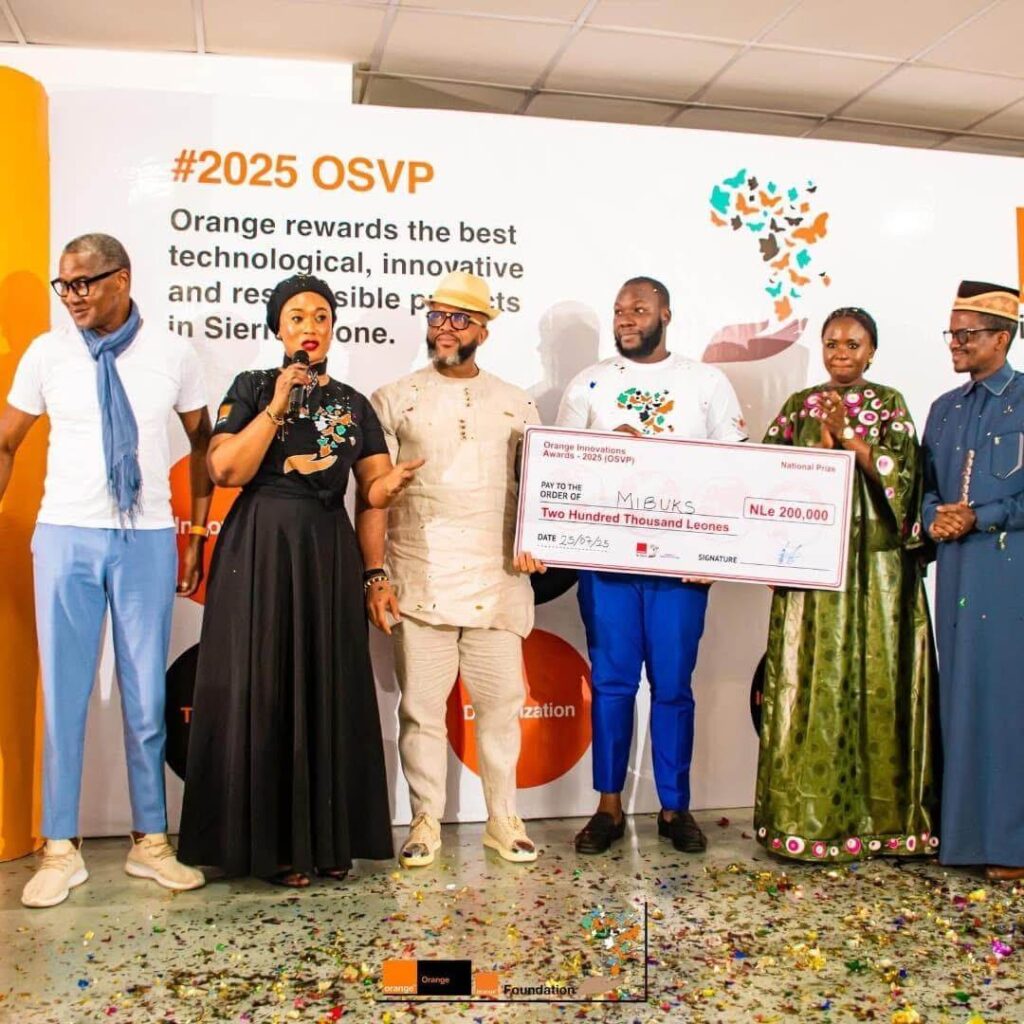
“The programme is not about perfection; it is about potential,” he explained, noting that OSVP is designed to support evolving ideas that address real-world challenges.
Through the initiative, Kamara gained not only recognition but also clarity, confidence, and the mentorship needed to refine his vision and strengthen his business model.
Developed by Millennial Sierra Leone, MiBuks provides digital tools to help micro, small, and medium-sized enterprises manage finances from recording sales and expenses to tracking inventory and performance, even in low-connectivity environments.
The platform addresses a critical gap in Sierra Leone’s informal business sector, where limited financial record-keeping often restricts access to growth opportunities and financing.
Following its OSVP win, MiBuks moved from concept to broader implementation. The platform is now available on both major app stores and has undergone continuous improvements driven by user feedback.
Today, MiBuks supports over 2,300 users across the 16 districts of Sierra Leone, including hard-to-reach areas such as Falaba, a reach that underscores the importance of inclusive and accessible innovation.
Kamara credits OSVP’s financial and mentorship support with helping MiBuks transition from a minimum viable product into a more stable and scalable solution.
The team has since strengthened its technical infrastructure, expanded its workforce, and introduced new features, including multi-language support and branch management tools for businesses operating across multiple locations.
Beyond product development, the programme also created space for deeper engagement with users, ensuring that the platform evolves in response to real business needs.
Expanding Access to Finance
MiBuks is now moving beyond bookkeeping into financial inclusion.
The company is finalising a partnership with Kakebo Financial Services to pilot a credit access initiative in Kenema district. The project aims to enable small businesses to use verified transaction data to support loan applications, a move that could unlock new opportunities for underserved entrepreneurs.
“This is where innovation delivers real value,” Kamara noted, “not through complexity, but by enabling opportunity.”
A Call to Young Innovators
Reflecting on his journey, Kamara said collaboration, mentorship, and initiative development are values he now passes on by supporting other young entrepreneurs.
Applications are currently open for the 8th edition of the Orange Social Venture Prize (OSVP) 2026, with entries accepted from 26 March to 17 May 2026.
The competition offers significant rewards, including:
- SLE 200,000 for the national winner
- SLE 120,000 for the Tech Queen (women’s category)
- €10,000–€25,000 in international prizes
- €20,000 International Women’s Prize
Kamara is urging aspiring innovators across Sierra Leone to take the leap.
“If you are working on an idea that addresses a real challenge, do not underestimate its potential,” he said. “Apply, even if you feel uncertain. Progress often begins with the decision to take part.”
For him, OSVP was more than a competition; it was a catalyst.
“It changed my life,” he said. “It might just change yours too.”