By Lawrence Williams
The European Union Ambassador to Sierra Leone has called for the swift extradition of convicted Dutch drug trafficker Jos Leijdekkers, warning that the case is harming Sierra Leone’s global reputation and undermining international confidence in the country’s fight against transnational organised crime.
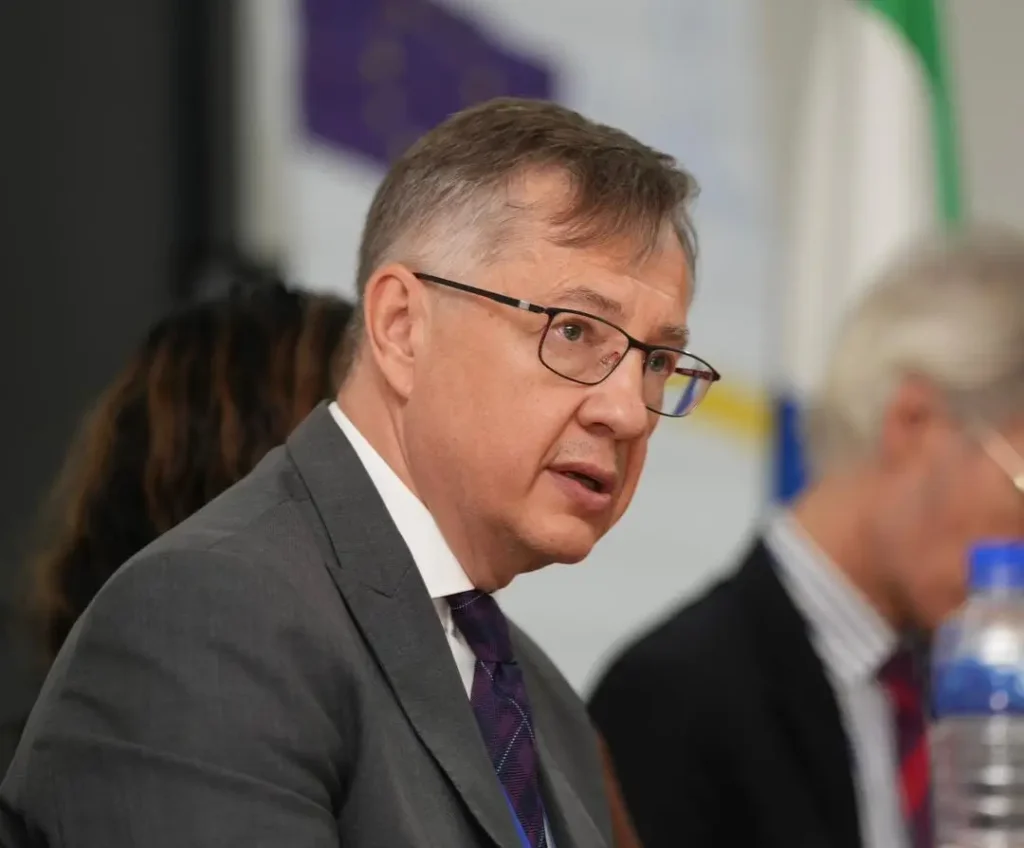
Ambassador Jacek Jankowski made the remarks while responding to questions from Fritong Post during a press launch marking the golden jubilee of the EU-Sierra Leone partnership, where he stressed the need for “sincere and honest cooperation” between Sierra Leonean and European judicial and law enforcement authorities regarding the case.
“We would like to see close cooperation and sincere cooperation on every item between the European Union, European Union member states, and the Sierra Leone government, including on the issue you mentioned of the Dutch national criminal,” the ambassador said.
The comments come amid mounting international scrutiny over the reported presence and protection of Leijdekkers in Sierra Leone. The Dutch national, regarded as one of Europe’s most wanted drug traffickers, has been convicted in Europe and remains the subject of an international manhunt linked to large-scale cocaine trafficking operations.
Jankowski referenced a recent meeting between Sierra Leone’s Minister of Justice and the Dutch Justice Minister, expressing hope that cooperation between the two governments would continue smoothly.
“Of course, as the European Union and European Union member states, we are against drug trafficking,” he said.
The EU envoy also acknowledged Sierra Leone’s limited capacity to police its borders and coastlines but noted that the bloc stands ready to support the country in strengthening border security and anti-trafficking efforts.
“We understand that the government of Sierra Leone has quite limited resources to protect their borders. And we, as the European Union, are also ready to support the government in building its capacity to control coastline and maybe land borders better to prevent drug trafficking,” he stated.
According to Jankowski, a significant portion of narcotics trafficked through West Africa eventually reaches European countries, making the issue a shared security concern for both Sierra Leone and the EU.
“A big part of the drugs ends up in the European Union member states, and we don’t want this,” he noted, adding that components linked to the deadly synthetic drug Kush have also reportedly moved from Europe into Sierra Leone.
The ambassador’s strongest remarks, however, focused on the reputational consequences of the Leijdekkers case.
“For us, the person who has been convicted in Europe should be sent to our member states, the Netherlands or to Belgium, as soon as possible,” he said. “Because this case has a very negative impact on the global perception of Sierra Leone.”
The remarks are expected to intensify pressure on Sierra Leonean authorities amid concerns that the country risks becoming a safe haven for transnational criminal networks operating across West Africa and Europe.
Leijdekkers has become a symbol of growing fears over cocaine trafficking routes through the region, particularly after a series of international investigations linked West African ports and political protection networks to European drug cartels.
The issue has also drawn wider international attention following the arrest last year in Dubai of Leijdekkers’ brother-in-law, who was later extradited to Turkey as part of ongoing international anti-narcotics operations. Meanwhile, Leijdekkers himself continues to enjoy protection in Sierra Leone despite mounting international calls for his arrest and extradition.