By Lawrence Williams
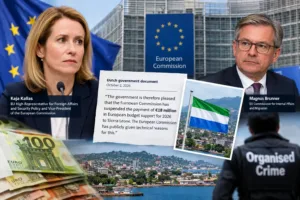
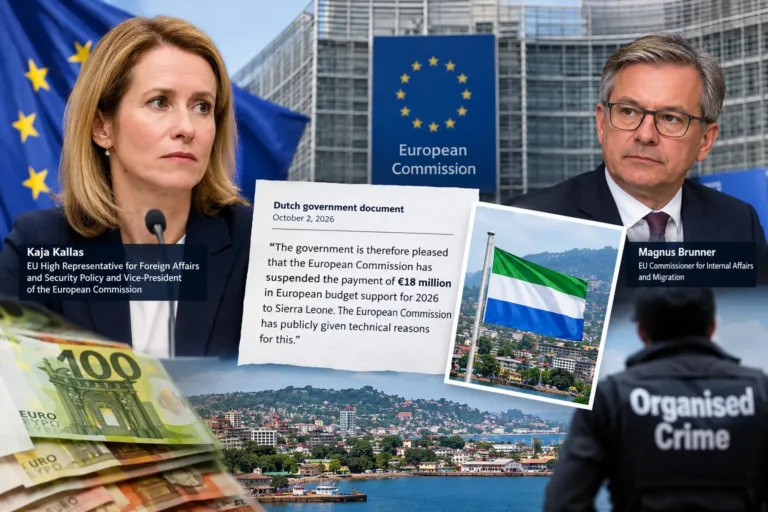
The European Union has stopped short of confirming that its decision to not proceed with a planned €18 million budget support disbursement to Sierra Leone was triggered by the country’s handling of Dutch fugitive Jos Leijdekkers case, despite claims by the Dutch government and an earlier Reuters report that the funding was suspended to pressure Freetown to cooperate with the extradition.
In response to a formal enquiry by Fritong Post, Luca Dilda, press officer for Foreign Affairs and Security Policy and the Mediterranean at the European Commission’s Directorate-General for Communication in Brussels, provided detailed figures on EU assistance to Sierra Leone but did not confirm that the 2026 budget support decision was a sanction linked to the Leijdekkers case.
Instead, Dilda said the EU is concerned about drug trafficking and trends in transnational organised crime in Sierra Leone and the wider region.
The issue has been raised with Sierra Leonean authorities on several occasions, including during a recent bilateral meeting between EU High Representative/Vice-President Kaja Kallas and Sierra Leone’s Foreign Affairs Minister Mohamed Raman Swarray on the margins of the 81st United Nations General Assembly in New York.
Drug trafficking is a serious concern to the EU and its member states are “currently looking into the measures that we, as EU, could take to address these issues,” said Dilda, referring to the European Council conclusions adopted in June that call for coherent action towards third countries harbouring drug traffickers and failing to comply with their obligations under international law.
It is no gainsaying that Leijdekkers matter is clearly on the EU’s political and security agenda, but it is different from saying that the decision concerning the €18 million budget support was itself imposed as a penalty for Sierra Leone’s failure to extradite him.
Dilda did not confirm or deny that specific allegation when put to him. Instead, he set out the financial position of the EU’s wider cooperation with Sierra Leone.
Under the EU’s 2021-2027 allocation for Sierra Leone, the EU has provided for €352 million in grant funding. Of that envelope, €245 million has so far been committed through various programmes.
Dilda stated that, as part of the funding, a €65 million budget support programme was signed with the government of Sierra Leone in 2024, of which €24.5 had already been disbursed. He stated that the €18 million payment for 2026 is not currently planned for disbursement but did not say why is that.
“The €18 million disbursement initially foreseen for 2026 is currently under assessment and no disbursement is currently planned,” said Dilda.
Whatever that means, the EU has not abandoned nor pulled out from Sierra Leone. Dilda says “the management of the remaining ongoing programmes benefitting the population has been delegated to external implementing partners and is not channelled through the Government of Sierra Leone.”
In June 2026, for example, the EU announced an €11.5 million contribution to a World Food Programme initiative supporting child nutrition and local food systems in Sierra Leone. In August, the EU also announced €175,000 in humanitarian assistance for flood-affected communities in the country, with Sierra Leone Red Cross Society as the implementing partner.
The controversy started on Oct. 1 after Reuters reported that the Dutch Justice Minister David van Weel had said the European Commission stopped €18 million in budget support to Sierra Leone because Freetown was not cooperating with the Netherlands over the extradition of Leijdekkers.
The Sierra Leone government dismissed the claim, saying the disbursement was postponed due to the timing of a request to amend the financing agreement and the difficulty of completing the required assessments within the 2026 reporting cycle. The government’s account suggested that the 2026 payment would be moved to 2027 and the 2027 payment to 2028.
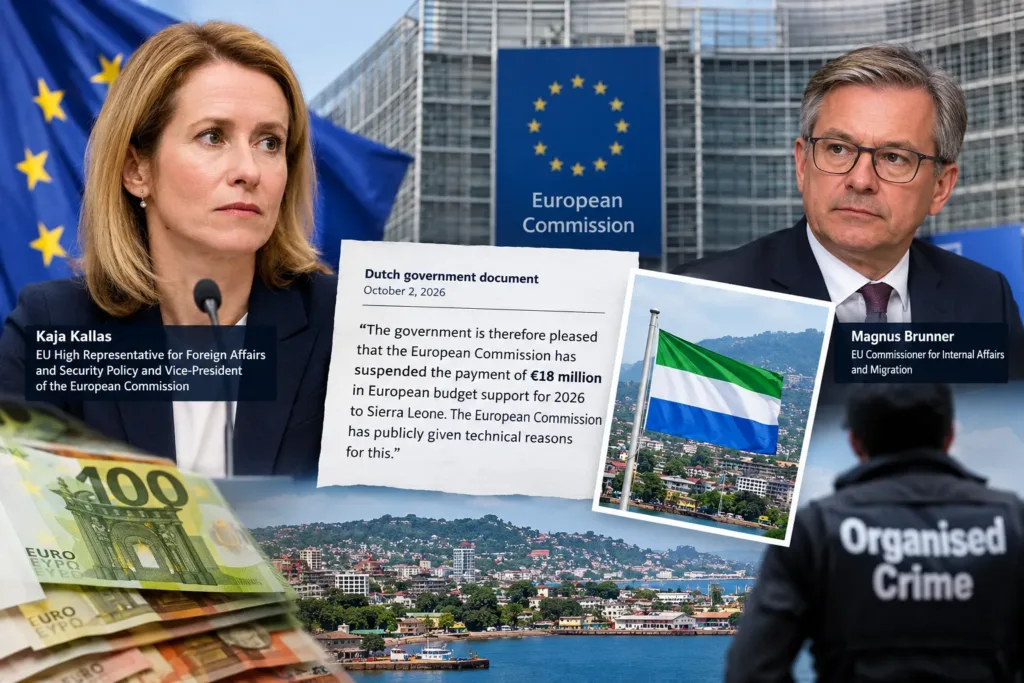
EU Commissioner for Internal Affairs and Migration Magnus Brunner later spoke to reporters in Luxembourg following Oct. 1 Justice and Home Affairs Council meeting.
According to the Dutch news agency ANP, Brunner said the suspension of budget support to Sierra Leone was due to “technical reasons” and that he could not provide further details because the matter was not his dossier. He did not establish a direct connection between the €18 million payment and Leijdekkers case.
At the same time, Brunner said the EU needs to act against third countries that provide shelter to drug traffickers and said the EU was concerned about drug trafficking, cross-border crime and organised crime in Sierra Leone.
Dutch public broadcaster NOS reported that Weel’s statements caused irritation in Brussels, with unnamed sources saying he was called back over the comments.
However, Weel subsequently disputed the suggestion that there had been any confrontation, saying he was unaware of the reported irritation and that he had a good relationship with Brunner.
Fritong Post has not been able to independently verify the claim that Brunner formally chastised or reprimanded David van Weel.
There is, however, evidence that the disagreement is not simply about semantics.
Dutch reporting shows that the Netherlands has been pushing for stronger European action against Sierra Leone over Leijdekkers for months.
NOS reported earlier this year that Weel had sought to use European development funding as part of broader pressure on Sierra Leone, after diplomatic efforts to secure Leijdekkers’ extradition had failed to produce the desired result.
A Dutch government document dated Oct. 2 and seen by Fritong Post confirms this position. The document says the Dutch government welcomed the €18 million ‘suspension’ while also acknowledging that the European Commission had publicly given technical reasons for the decision.
“The government therefore welcomes the European Commission’s decision to suspend the disbursement of €18 million in European budget support to Sierra Leone for 2026. The European Commission has publicly cited technical reasons for this decision,” the document stated.
The Dutch government clearly views the suspension as part of a broader effort to pressure Sierra Leone over drug trafficking and the Leijdekkers case whilst the European Commission has only given “technical reasons.”
The Netherlands is unrelenting on Leijdekkers case and has vowed to continue pushing for an EU sanctions regime targeting organised crime.